
The U.S.-Iran confrontation has entered a new phase of escalation, with the scope of military operations widening to include sites in the Gulf and facilities linked to U.S. forces, coinciding with increasing security incidents in the Strait of Hormuz, one of the world’s most strategic maritime routes for energy trade.
The rapid developments on Wednesday, 18 November 2026, come at a time when fears are growing that the confrontation between Washington and Tehran could turn into a regional crisis that exceeds the two parties’ borders, especially as Gulf states enter the circle of events and maritime navigation faces escalating risks.
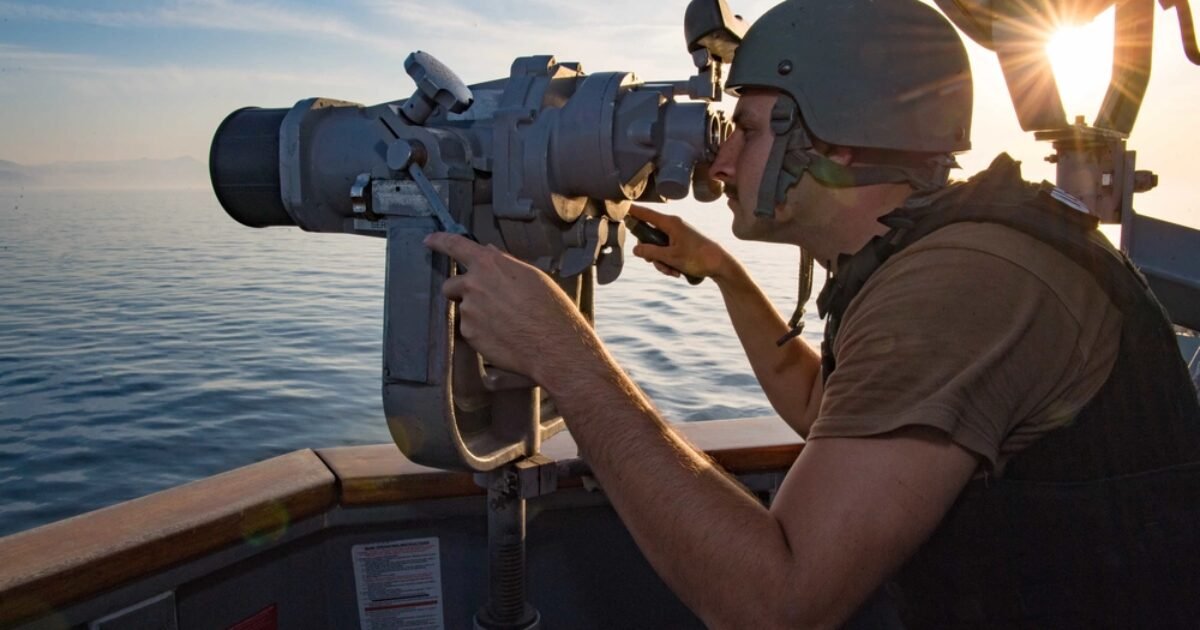
1. U.S. destroyer transiting the Strait of Hormuz 14 November 2018 – archive photo Photographer: Jonathan Clay – U.S. Navy.[/caption>

Reciprocal strikes hit military sites in the Gulf
The United States announced it carried out strikes targeting a rocket-launch site belonging to the Islamic Revolutionary Guard Corps (IRGC) on Qeshm Island in the Strait of Hormuz, according to media reports citing a U.S. military official.
The strikes followed the IRGC’s announcement that it had targeted a U.S. radar system at Sheikh Isa Air Base in the Kingdom of Bahrain using unmanned aerial vehicles, justifying the operation as a response to what it described as repeated U.S. violations of Iranian airspace.
In turn, U.S. Central Command said it intercepted the drones that targeted the radar system, noting that no equipment damage or U.S. personnel injuries were reported.
In an additional development, the Iranian army announced it had struck U.S. military facilities at Ali Al Salem Air Base in Kuwait, including air defense systems and platforms for launching drones and missiles.
Kuwait announced that its air defenses had repelled attacks by unmanned aerial vehicles, and condemned what it described as repeated Iranian assaults on its territory, considering them a direct threat to its security and stability.
Bahrain also said its air defenses dealt with Iranian attacks, in a development that reflects the widening scope of the confrontation and the increasing security risks to regional states.
The Strait of Hormuz… the most dangerous front in the confrontation
The seriousness of the current escalation goes beyond military facilities to one of the most sensitive locations for the global economy: the Strait of Hormuz.
Abu Dhabi National Oil Company (ADNOC) Supply & Services of the UAE said that one of its vessels was attacked while transiting the strait on the evening of Tuesday, 17 November, resulting in 11 people wounded and one crew member missing, while search and rescue operations continue.
In a separate incident, an oil tanker was reported to have been struck by an unidentified projectile inside the Strait of Hormuz, ca using a fire aboard approximately 13 nautical miles north of the Omani city of Khasab, according to the UK Maritime Trade Operations.
These incidents raise growing concerns about the safety of commercial ships and oil tankers, particularly since any prolonged disruption to navigation through the strait could directly affect energy supplies, oil prices, and shipping and marine insurance costs.
The importance of the Strait of Hormuz lies in its role as a major transit route for oil and gas exports from Gulf states to global markets, making its security an issue that transcends the military and political calculations of the confronting parties.
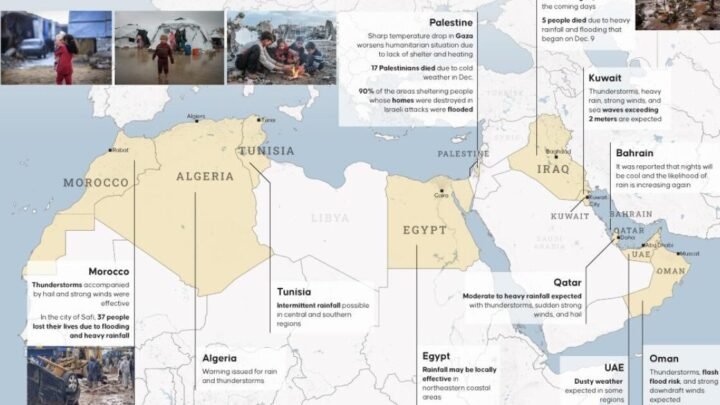
2. U.S. aircraft carrier USS Dwight D. Eisenhower 11 October 2016 – Persian Gulf – Photographer: Casey J. Hopkins – U.S. Navy.[/caption>

Qatar and Kuwait… warnings of a widening confrontation
On the diplomatic level, Qatar condemned the Iranian attacks on Kuwait and Bahrain, calling them violations of the two states’ sovereignty and a threat to regional stability.
Doha stressed the need to adhere to international law and to prioritize dialogue and diplomatic solutions, warning that continued assaults would undermine efforts to contain tensions.
Kuwait, for its part, affirmed its right to take necessary measures to defend its sovereignty, security and vital facilities, in accordance with international law.
These positions place the Gulf states before a highly sensitive security equation: protecting their territories, facilities and sea lanes while avoiding becoming an open arena for military score-settling between regional and international powers.
Yemen and Gaza… other fronts that complicate the picture
Parallel to the escalation in the Gulf, confrontations continue in Yemen, where the Saudi-led coalition announced it conducted extensive air strikes against Houthi positions, saying they targeted military installations and missile and drone capabilities.
In turn, Houthi health authorities reported deaths and injuries from the raids, while The Associated Press reported at least 17 people killed according to figures released by the group.
In the Gaza Strip, Israeli strikes continue despite a ceasefire agreement, with Palestinian casualties reported in new strikes, according to Palestinian hospital reports.
The simultaneity of these developments reflects the interconnectedness of security issues in the Middle East, where any escalation on one front can affect the calculations of parties on other fronts.
Is the region approaching a full-scale regional war?
The main question posed by the current developments is not only about the size of the reciprocal strikes, but about the limits of escalation each side can accept, and the ability of international and regional powers to prevent the confrontation from turning into an open war.
Washington seeks to protect its forces, facilities and strategic interests in the Gulf, while Tehran says its operations are carried out in response to U.S. and Israeli strikes and threats.
But the widening circle of targeting to include facilities in Gulf states, alongside threats to commercial shipping, raises the cost of any new confrontation and increases the likelihood of military mistakes that may be difficult to contain.
Diplomatic mediations, notably contacts led by regional countries, remain a key factor in preventing the region from sliding into a wider confrontation.
Conclusion: The U.S.-Iran escalation is no longer merely a military confrontation between Washington and Tehran; it has become a test for the security of the Gulf, the stability of energy markets and the freedom of international navigation. Between reciprocal strikes and diplomatic maneuvers, the region faces an extremely sensitive phase whose outcomes will be linked to the parties’ ability to manage escalation and prevent the widening of the confrontation.
Press sources:
-
Al-Araby TV – Live coverage of the escalation.
-
Anadolu Agency – The Arab political agenda.