Amazing Simulation Reveals The Secrets Of Black Holes

Amazing Simulation Reveals The Secrets Of Black Holes

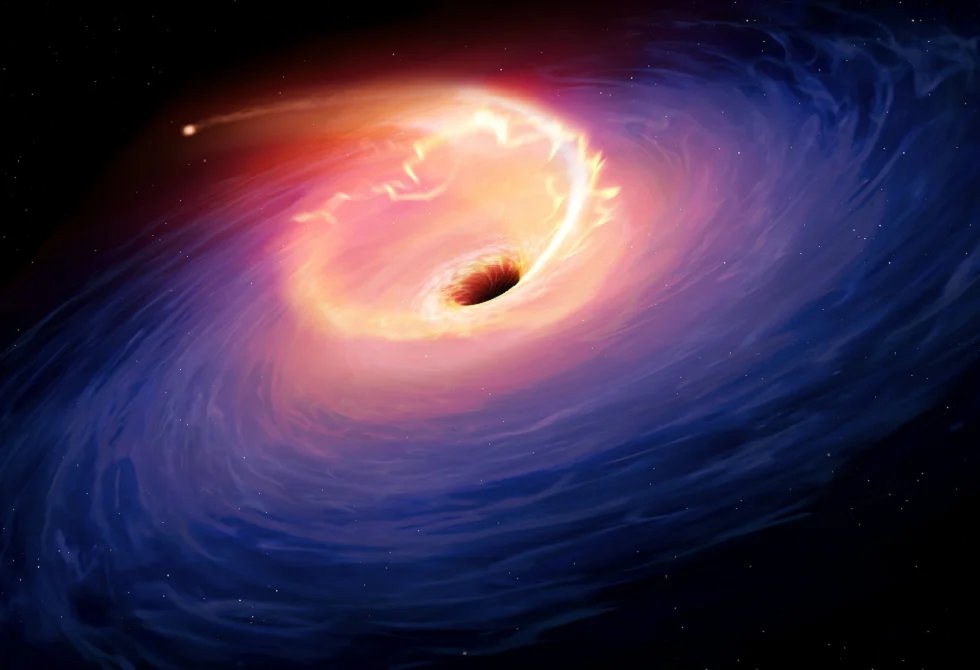

In this simulation, the center of the black hole appears as a dark, empty space, simply because no light is reflected from it, while vibrant colored patterns of purple, pink and orange surround it.
These displays arise as a result of the emission of energy from materials when they fall into the black hole, whether it is gas, dust, or solid matter.
Black holes are powerful sources of gravity, attracting dust, gas, and even planets, and sometimes other black holes. Because of this enormous gravity, if a nearby object falls, it undergoes what is known as the “spaghetti phenomenon,” where it is pulled and stretched by gravitational forces.
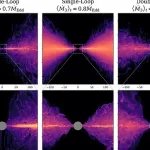
Scientists have just published the most complete set of simulations to date showing how black holes turn infalling matter into the intense light we observe.
Using two of the world’s most powerful “exascale” supercomputers, researchers modeled how gas and dust swirl into… pic.twitter.com/iGqMD8kLld
— Erika (@ExploreCosmos_)Scientists have just published the most complete set of simulations to date showing how black holes turn infalling matter into the intense light we observe.
Using two of the world’s most powerful “exascale” supercomputers, researchers modeled how gas and dust swirl into…pic.twitter.com/iGqMD8kLld
— Erika (@ExploreCosmos_)December 4, 2025
The black hole attracts surrounding material to form a bright orange accretion disk orbiting it. This hot disk is the main source of light, allowing scientists to detect black holes in galaxies billions of light-years away.
Scientists have taken high-resolution images of supermassive black holes, whose mass reaches hundreds of millions or billions of times the mass of the Sun. These holes develop over years or centuries and influence the formation of galaxies.
Smaller stellar black holes cannot be detected in the same way, as they appear as tiny points of light. To simulate the accumulation of these holes, the team used the world’s most powerful supercomputers, such as Frontier and Aurora, which can perform a quintillion (i.e., a billion billion) calculations per second.
With this power, the team was able to study how matter rotates around these holes, although complex mathematics and improved algorithms were needed to ensure accuracy.
Simulations showed that the material forms highly turbulent disks dominated by radiation, emitting strong winds and sometimes energy jets. However, the accretion disk near the black hole remains relatively stable thanks to a magnetic shell that keeps the system stable.
These results, published in the Astrophysical Journal, represent the first time that the physical processes in stellar black hole accretion have been calculated with high precision. Previous simulations simplified radiation and treated matter as a liquid, which did not accurately reflect its actual behavior.
Scientists hope to expand in the future to study whether this calculation method applies to all types of black holes, including massive holes located in the centers of major galaxies.
Source: Daily Mail
Disclaimer: This news article has been republished exactly as it appeared on its original source, without any modification. We do not take any responsibility for its content, which remains solely the responsibility of the original publisher.
Author:
Published on:2025-12-06 15:39:00
Source: arabic.rt.com
UAETodayNews delivers the latest news and updates from the UAE, Arab world, and beyond. Covering politics, business, sports, technology, and culture with trusted reporting.
Disclaimer: This news article has been republished exactly as it appeared on its original source, without any modification. We do not take any responsibility for its content, which remains solely the responsibility of the original publisher.
Author: uaetodaynews
Published on: 2025-12-06 23:31:00
Source: uaetodaynews.com

Default author bio in English. Add your expertise, links, and contact info here to boost E-E-A-T. | نبذة افتراضية عن الكاتب بالعربية. أضف خبراتك، روابطك، ومعلومات الاتصال هنا لتعزيز E-E-A-T.